

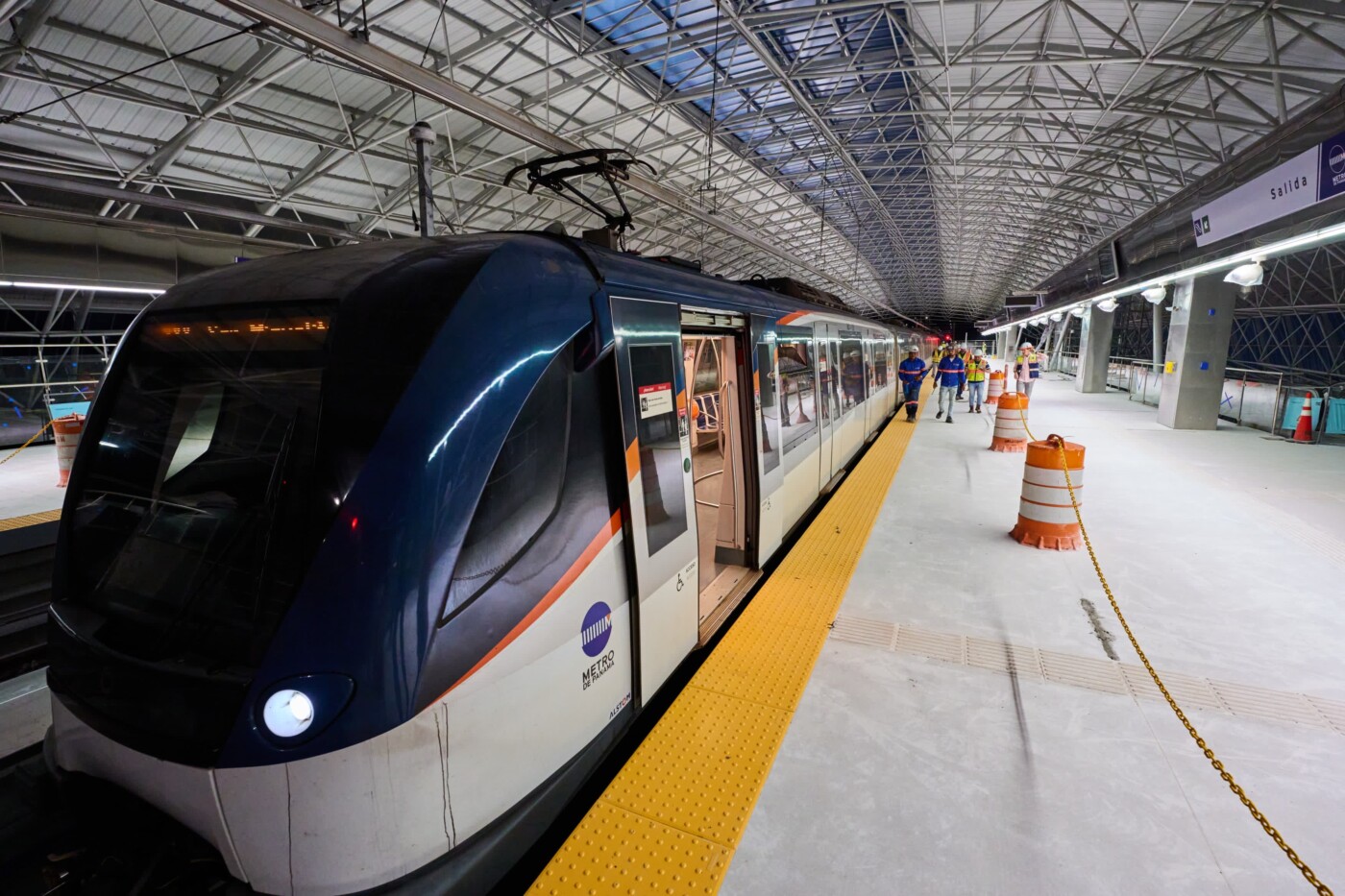
By the time the morning traffic begins to stack up on the Bridge of the Americas, the future relief for Panama Oeste’s commuters is already taking shape a few kilometres away.
On one side of the Canal, a 13-metre-class tunnel boring machine named Panamá is grinding slowly under the shipping lane, assembling a pressure tunnel more than 60 metres below the water surface. On the other, concrete piers and precast beams are marching along the Pan-American Highway toward Ciudad del Futuro, where a new depot will anchor the country’s first monorail.
When it opens in stages later this decade, Line 3 of the Metro de Panamá will be the country’s most consequential mobility investment since the Canal expansion: roughly 25 kilometres of mostly elevated guideway in its first phase between Albrook and Ciudad del Futuro, expanding to about 34 kilometres when a second phase pushes west to La Chorrera. It is designed to carry around 160,000 passengers a day and to serve a catchment of more than half a million residents in Panama Oeste.
For government and lenders, though, Line 3 is not just another line on the map. It is the mechanism for unblocking the west side’s role in the national economy—recovering thousands of lost commuter hours every day, de-risking further residential and industrial growth in Panama Oeste and extending the time-saving, emission-cutting benefits already proven on Lines 1 and 2.
Proof of concept: Lines 1 and 2 de-risk the bet
By the time construction proper began on Line 3 in 2021, Panama’s first two metro lines had already turned rail transit from a political experiment into an operational baseline.
Line 1, a north–south heavy-metro corridor, opened in 2014 and quickly stabilised at roughly a quarter of a million riders a day, exceeding early forecasts. Line 2, which opened eastward in 2019 and has since been extended toward Tocumen International Airport, operates at up to roughly 400,000 passengers daily at full design capacity. Together they have become the city’s primary urban spine, cutting cross-city journey times on key corridors to around 20–25 minutes where comparable bus trips once took much longer.
Development banks and independent assessments link those time savings directly to labour-productivity gains and better job access for lower-income riders. Traffic and fuel-use data show a steady shift of trips from cars and diesel buses to electric rail, translating into lower greenhouse-gas emissions and fewer local pollutants than the pre-metro baseline. Metro expansion is now treated by financiers as a tested instrument for productivity and climate policy, not a speculative bet.
For investors and contractors, that performance effectively de-risked Line 3. The system had demonstrated that Panamanians will use rail when it is fast, frequent and affordable; that the operator can keep complex infrastructure running; and that lenders can view metro extensions as part of a stable, repeatable programme.
The gap was geographic. Lines 1 and 2 serve the core and the eastern flank of the metropolitan area. They barely touch Panama Oeste. For hundreds of thousands of residents in Arraiján, Nuevo Chorrillo and La Chorrera, the daily choice remained binary: bus or car across a bridge and a highway that can turn a 25-kilometre trip into a 90–120-minute crawl.
Line 3 is the first piece of infrastructure designed to structurally fix that imbalance.
Why a monorail west of the Canal
Officially, Line 3 is “Panama Metropolitan Area Urban Transportation Line-3”—a dry title for a simple idea: connect the western suburbs to the capital with high-capacity, segregated rail that is independent of Canal bridge traffic.
Phase 1 runs roughly 24½–25 kilometres from an interchange at Albrook (connecting with Line 1) out through Panama Pacífico, Arraiján and Nuevo Chorrillo to Ciudad del Futuro, serving a string of elevated stations at major catchment points. A second phase will push the line on to La Chorrera, taking the total corridor length to about 34 kilometres and extending its reach deeper into Panama Oeste.
Two design decisions are central to the project’s business logic.
The first is technology. Line 3 is a straddle-type monorail, not a continuation of the heavy-metro platform used on Lines 1 and 2. The elevated guideway—precast concrete beams on single piers—threads along and across the Pan-American Highway through hilly terrain and tight sites. Monorail allows steeper gradients and tighter curves than conventional metro, trims the structural footprint above congested roads and reduces the number of long-span structures required.
In business terms, that choice buys Panama more capacity per corridor metre, lower visual and structural impact over existing highways and a clearer approvals path, while maintaining metro-level frequency and reliability.
The second is the Canal crossing. Earlier plans had Line 3 running on a rail deck on the long-planned Fourth Bridge. As that road megaproject stalled, the risk of coupling the west-side rail investment to a separate, politically complex structure became harder to justify. Metro de Panamá and its lenders ultimately opted for a dedicated bored tunnel under the Canal between Albrook and Panama Pacífico.
The pivot front-loads engineering risk into a single, tightly managed package—one tunnel drive, one specialist supply chain, one scope under the metro’s control—rather than spreading it across an external bridge interface. It has increased capex, but it has also simplified risk allocation.
For riders, the promise is straightforward: cut typical peak-hour journeys between Panama Oeste and the city from 90–120 minutes down toward 35–45 minutes, with far more predictable arrival times. For planners, the line is designed for an initial peak capacity of around 20,000 passengers per hour per direction—enough to absorb current demand with room to grow.
Inside the trains: Japanese monorail, tropical operating conditions
If Line 3’s structures are shaped by Panama’s topography and the Canal, its trains are decisively Japanese.
Under a major rolling-stock and systems contract, a Hitachi-led consortium with Hitachi Rail and Mitsubishi is supplying six-car monorail sets, along with electrification, signalling, communications, platform screen doors, a central control centre and depot equipment. The trains are based on a proven platform with a long operating record in Osaka and other Asian cities.
Each set runs close to 90–95 metres long and roughly three metres wide, with a crush-load capacity of around 1,000 passengers—about a quarter seated and the rest standing. A bank of rubber-tyred bogies and multiple traction motors gives each train enough power to handle steep gradients at a maximum speed above 90 km/h, even though commercial operations will sit closer to 80 km/h.
The point is not raw horsepower. It is the ability to maintain timetable reliability on steep grades in hot, wet conditions, where under-powered rolling stock would quickly eat into performance margins and erode public confidence.
Energy efficiency is built into the traction system. Regenerative braking feeds energy back into the line, trimming overall consumption, while on-board and wayside batteries provide a “get to the next station” safety margin if grid power is lost. For an operator, that combination reduces operating costs per train-kilometre and avoids catastrophic service disruptions that can damage a young system’s reputation.
On the control side, communications-based train control and a centralised operations room—integrated with or interfaced to the existing OCC for Lines 1 and 2—will support peak headways on the order of four minutes. That level of automation and visibility is what allows the owner to extract the full capacity that the civil infrastructure is being built for.
For passengers used to the narrower heavy-metro cars of the existing lines, Line 3’s trains will feel different: wider interiors, large doorways, dedicated spaces for people with reduced mobility, full-height platform doors and clearer real-time information inside the cars.
Under the Canal: managing deep-tunnelling risk
Where Line 3 departs most dramatically from its predecessors is not in what riders will see, but in what they will never see at all.
To cross the Canal, Metro de Panamá opted for a deep bored tunnel, abandoning the idea of using a shared deck on the Fourth Bridge. The result is one of the most technically demanding pieces of urban tunnelling in Central America: several kilometres of large-diameter tunnel at depth, in mixed ground, under a world-critical shipping lane.
The TBM Panamá—a mix-shield machine more than 90 metres long with a cutterhead around 13 metres in diameter—is being launched from a shaft at Farfán to drive beneath the navigation channel toward a reception shaft on the opposite bank. At its lowest point, the tunnel crown sits more than 60 metres below the Canal bed, under high hydrostatic pressures and in variable soils.
The machine advances ring by ring, erecting a precast concrete segmental lining behind the cutterhead. Each ring is gasketed and bolted to withstand external water pressure; grout injection behind the lining fills the annulus and locks the tunnel into the ground. Ventilation, smoke extraction, drainage and evacuation walkways are built into the design, along with cross passages and emergency shafts to meet international life-safety standards.
For Metro de Panamá and its lenders, the deep-bored solution has clear advantages. It concentrates the highest geotechnical and construction risk into a single, well-defined scope, with a clear chain of accountability, rather than tethering rail operations to the schedule and politics of a separate highway megaproject. It also creates an asset that is entirely controlled by the metro authority, with no long-term structural interface to a road bridge owner.
The Canal crossing is also where the global supply chain and local industry intersect most visibly. A Panamanian reinforcement specialist, ERSI Group, is supplying the reinforcing steel for thousands of tunnel lining segments and for the heavy piles that carry much of the elevated guideway. To do so, it has scaled up prefabrication lines capable of producing large-diameter cage assemblies in industrial quantities—capacity that simply did not exist in the country when Line 1 was tendered a decade ago.
Financing a US$4 billion corridor
Behind the engineering sits an institutional and financial architecture that looks very different from the early days of Line 1.
Metro de Panamá S.A. acts as project owner and contracting authority. For the core civil works and basic systems, it selected the HPH consortium—Hyundai Engineering & Construction, POSCO E&C and Hyundai Engineering—as design–build contractor under a contract initially worth around US$2 billion. On the systems side, the Hitachi–Hitachi Rail–Mitsubishi package covers rolling stock, power, signalling and platform screen doors.
As scope evolved from a bridge-based Canal crossing to a deep tunnel and as global construction costs rose, the overall project envelope has moved from roughly US$2.8 billion at award to close to US$4 billion today. The main drivers are the added complexity of the tunnel solution, inflation in materials and labour, and additional systems and risk-mitigation features agreed with lenders.
On the financing side, the structure is deliberate rather than improvised. Long-tenor, concessional yen loans from JICA fund much of the tunnel and systems work, reflecting Japan’s strong export and climate objectives. Export credit and commercial bank participation sits behind key packages, while multilateral institutions have arranged significant A/B loan structures linked to certified project receivables.
The result is a mix that spreads risk, locks in lower rates for the most complex elements and creates a template that can be reused on future metro phases: sovereign-backed ODA for big underground and systems work; capital-market instruments where cashflows are clear; and a competent, professional owner in the middle.
As on most megaprojects, the schedule has proved elastic. Construction started in 2021 with talk of completion in the mid-2020s. As scope clarified and the tunnel decision bedded in, the programme was re-baselined: Phase 1, the elevated section to Ciudad del Futuro, is now targeted for opening around 2027; Phase 2, the Canal tunnel and remaining works to Albrook, around 2028.
Short-term labour disruption has been part of that story. A high-profile construction strike in 2025 over overtime and collective-agreement compliance paused work for several days before being resolved between the HPH joint venture and the construction union. For owners and EPCs elsewhere, the episode is a reminder to build structured labour-engagement and grievance mechanisms into project governance from day one, especially on long-duration, multi-shift contracts.
Global primes, local muscle
Viewed from the depot or a station box, Line 3 looks like a tightly coordinated Korean–Japanese engineering exercise. Follow the supply chain and a more strategic picture emerges: global primes setting standards and architecture; local firms delivering physical work at scale; digital tools binding them together.
On the civil side, HPH’s joint-venture structure brings Korea’s metro and rail experience into a new geography, supported by Spanish, Japanese and Panamanian design teams working in a common BIM environment. Shared models and a single common-data environment have significantly shortened decision cycles across time zones and languages.
ERSI Group, already a familiar name from earlier lines and Canal-related works, has effectively become Metro de Panamá’s default heavy-rebar and pile-cage specialist. For Line 3, its prefabrication facilities can turn out thousands of tonnes of prefabricated steel piles and segment reinforcement per month, feeding an industrialised construction process for both guideway and tunnel. That capability simply did not exist locally when the first metro contracts were let.
Systems-assurance specialist Ricardo gives the owner and JICA a single point of responsibility for safety and reliability across design and construction. The early-stage Canal-tunnel design was led by a consortium including Typsa and Louis Berger, while specialist suppliers such as coupler manufacturers and platform-door vendors slot into the Korean and Japanese systems architecture.
For Panama’s construction sector, the metro programme has quietly become a form of industrial policy. By staging Lines 1, 2 and 3 back-to-back and insisting on local content, Metro de Panamá has allowed firms like ERSI and other Panamanian specialists to invest in people, plant and process that are now being redeployed into water, energy, healthcare and road projects. For global primes, that depth of local capability reduces execution risk and improves competitiveness on the next wave of bids.
Impacts, operations and a wider playbook
By late 2020s, when Line 3 is fully open, its benefits will be measured on several fronts that matter to C-suite leaders and policymakers alike.
On the mobility side, the corridor is designed to capture a major share of Panama Oeste’s commuting flows, shifting tens of thousands of daily trips from congested road bridges to a segregated, high-capacity rail line. That is expected to recover thousands of commuter hours every day—time that can be reallocated to work and family—and to make daily operations more predictable for employers that currently lose productivity to traffic.
On the economic side, the construction phase is supporting several thousand direct jobs on site and many more in the supply chain at peak. Over the longer term, experience from Lines 1 and 2 suggests that station areas along Line 3 will see a gradual intensification of residential and commercial development, with higher land values near stations, more retail and services nodes and a shift away from low-density, car-dependent expansion into more transit-oriented growth.
From a climate and environmental perspective, Line 3 extends to the west the same suite of co-benefits already observed on the first two lines: fewer private-car and diesel-bus kilometres on congested arteries, lower fuel use, less wear and tear on road assets, fewer accidents and a meaningful reduction in local air pollutants. Over the project life, lender models suggest the metro programme as a whole will avoid tens of thousands of tonnes of CO₂ compared with a roads-only development path.
On the operations and lifecycle-cost front, the integrated Hitachi platform—rolling stock, power, signalling and platform doors from a single supplier—should simplify maintenance, concentrate accountability and keep whole-of-life costs more predictable, provided spare-parts strategies are localised and skills transfer is embedded into the operating model. The depot and training centre at Ciudad del Futuro will be key to building a local workforce capable of sustaining the system.
Perhaps the most important impact, though, is institutional.
Line 3 tests Panama’s ability to manage a multi-phase, multi-billion-dollar urban transport investment that combines deep tunnelling, advanced systems and complex social and environmental obligations under intense public scrutiny. How it performs—on safety, schedule, cost and, ultimately, ridership—will influence not only whether La Chorrera gets its extension, but also how quickly future lines are green-lit and how easily the country can finance other large pieces of infrastructure.
If Line 3 delivers as planned, Metro de Panamá’s three-line network becomes more than a national achievement. It becomes a playbook for other mid-sized cities: start with a high-impact spine, demonstrate ridership and emissions gains, then extend to underserved growth corridors using a repeatable financing and delivery model.
For the commuter who, a few years from now, steps onto a violet-branded monorail at Ciudad del Futuro and steps off 40 minutes later at Albrook, the value will be measured not in billions, but in hours of life quietly taken back from traffic. For the CEOs, financiers and contractors watching from afar, Line 3 will be a test case for how far a relatively small country can push its rail infrastructure when it treats metro expansion with the same seriousness it once reserved for the Canal.
 Metro De Panama Line 3 - BE Magazine 2025.pdf